
The safest countries in the world in 2026
Safest countries in the world in 2026: one score out of 100 per country, from public data only (crime, health, stability, climate, cyber).

Co-Founder & Travel Insurance Expert
What is the safest country in the world in 2026?
- Singapore (98.7), Switzerland (98.4) and Norway (98.0) are the three safest countries to travel to.
- Europe places 12 countries in the top 15; Asia enters with Singapore (1st) and Japan (8th), Oceania with Australia (10th).
- Mauritius (76.6) is the safest country in Africa, Canada (93.3) leads the Americas, the United States ranks 38th (82.3).
- Coverage grew from 50 to 181 countries on a fully reproducible, public-data model: UNODC, World Bank, WHO, ITU, ND-GAIN.
2026 ranking of the safest countries in the world
Every published country ranked worldwide on the same 0–100 score. Click a country for its five pillar scores.
 Singapore
Singapore scores 98.8/100, #1 worldwide and #1 in Asia. Its strongest pillar is Public safety & crime (100.0), its weakest Political stability (96.6). Before you go, look for cover for trip cancellation and early return.
The geography of safety
Every published country in its tier colour. Click a tier to show or hide it, click a country for its rank and score.
Why are some countries grey? All 181 countries are scored, but this page only shows the 15 safest of each region. Scores below that line exist in our dataset and are not mapped, to keep the index a ranking of safe destinations rather than a warning list. What this study does not show ↓
Safest countries by region
Each continent ranked on its own: the 15 safest countries of each region, with their place in the world ranking. This is where most readers start. Each region also has its own ranking: the safest countries in Africa, in Europe, in the Americas, in Asia and in the Middle East.
Safest countries in Europe
- 1
 Switzerland98.5#2
 - 2
 Norway98.1#3
 - 3
 Sweden97.4#4
 - 4
 Finland96.8#5
 - 5
 Denmark96.6#6
 - 6
 Iceland96.2#8
 - 7
 Luxembourg96.2#9
 - 8
 Netherlands94.2#11
 - 9
 Ireland94.1#12
 - 10
 Germany94.0#13
 - 11
 United Kingdom93.7#14
 - 12
 Austria93.4#16
 - 13
 Estonia90.8#19
 - 14
 France90.7#20
 - 15
 Slovenia90.3#21
Safest countries in Asia











Safest countries in Americas
- 1
 Canada93.6#15
 - 2
 United States81.2#38
 - 3
 Chile78.5#43
 - 4
 Barbados77.4#47
 - 5
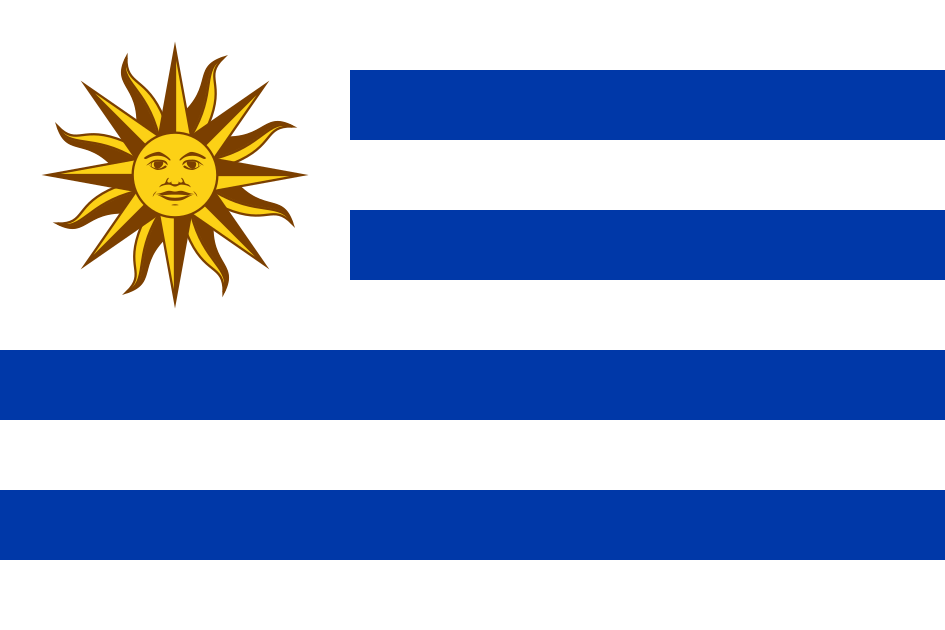 Uruguay75.9#53
 - 6
 Argentina69.2#74
 - 7
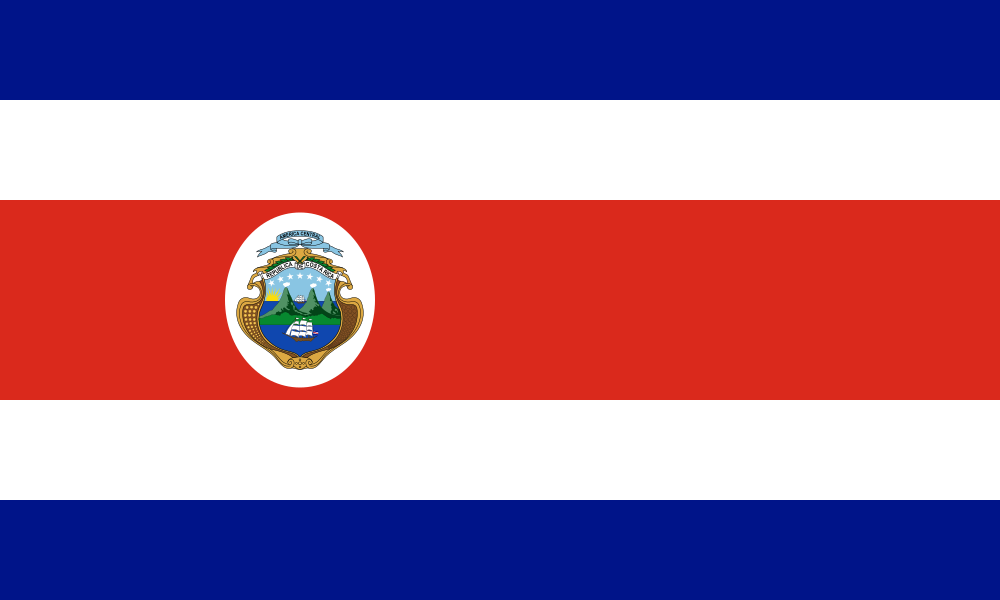 Costa Rica68.8#75
 - 8
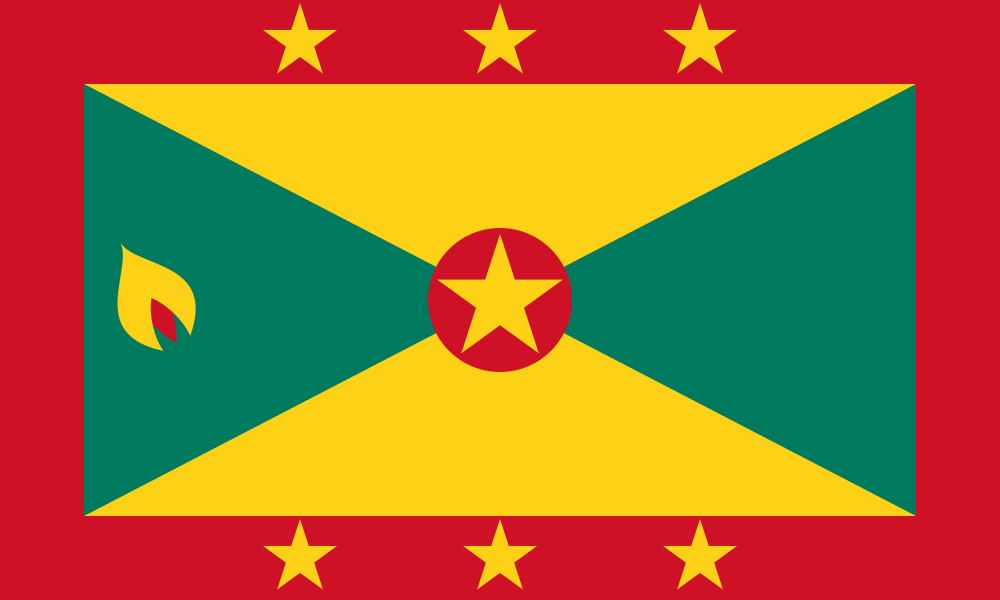 Grenada68.6#77
 - 9
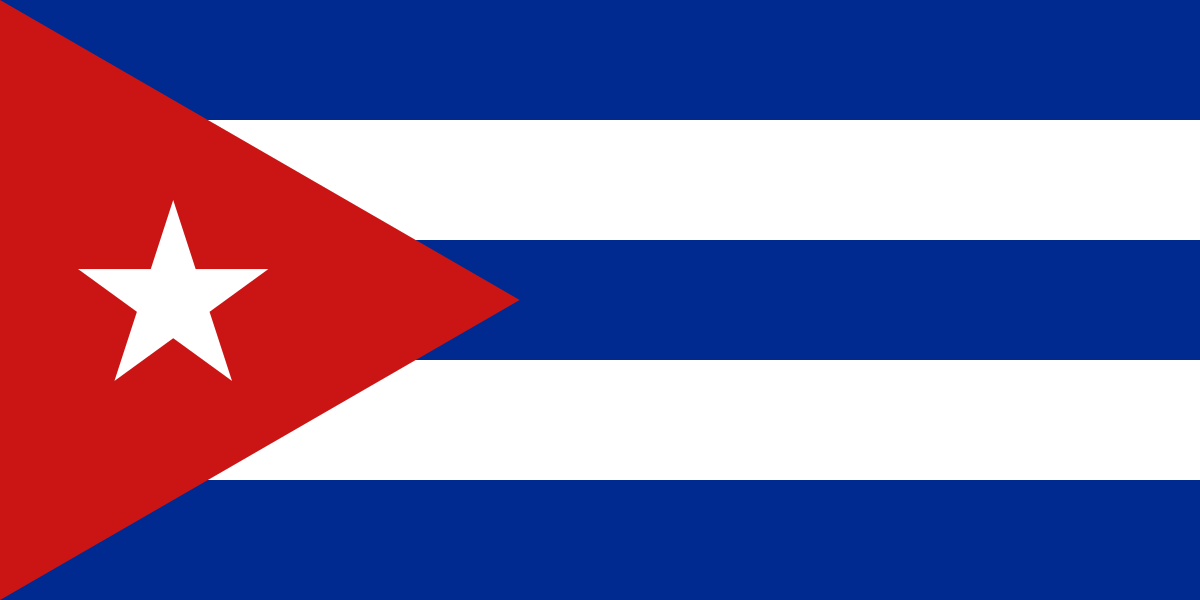 Cuba67.6#81
 - 10
 Peru64.4#91
 - 11
 Panama64.0#93
 - 12
 Suriname63.5#95
 - 13
 Paraguay60.9#102
 - 14
 Brazil57.3#111
 - 15
 El Salvador56.7#114
Safest countries in Africa
- 1
 Mauritius77.0#48
 - 2
 Seychelles72.4#63
 - 3
 Morocco68.8#76
 - 4
 Egypt67.2#83
 - 5
 Algeria65.6#86
 - 6
 Tunisia65.6#87
 - 7
 Cape Verde64.9#90
 - 8
 Ghana62.3#96
 - 9
 Rwanda60.7#105
 - 10
 Botswana59.1#107
 - 11
 Zambia57.3#112
 - 12
 Senegal56.8#113
 - 13
 Tanzania55.8#117
 - 14
 Benin55.4#119
 - 15
 São Tomé & Príncipe55.4#120
Safest countries in Oceania
- 1
 Australia95.5#10
 - 2
 New Zealand92.7#18
 - 3
 Micronesia69.9#69
 - 4
 Fiji69.4#73
 - 5
 Vanuatu68.2#78
 - 6
 Kiribati68.0#79
 - 7
 Samoa67.2#82
 - 8
 Tonga60.9#103
 - 9
 Solomon Islands60.8#104
 - 10
 Papua New Guinea50.5#133
Reader service: in high-ranked destinations where private healthcare is expensive (Singapore, Japan, South Korea), compare policies by medical limit with our travel insurance comparison. The United States, 38th, is covered in our guide to travel insurance for the USA. Also check the medical repatriation cover before a long-haul trip. To check which destinations your passport opens without a visa beforehand, see the HelloSafe Passport Index.
The safest countries to visit, to live in and for women
Methodology
Built by HelloSafe's travel insurance team, independently of our comparison. Every figure comes from a public international dataset, so the ranking can be reproduced from the sources.
Formula Safety Index = 0.35 × Safety + 0.25 × Health + 0.20 × Stability + 0.15 × Environment + 0.05 × Cyber
- Only the 15 safest countries of each region are published; lower scores stay in the dataset.
- Micro-states under 100,000 inhabitants are excluded.
- Sovereign states only: UN member states are ranked; territories are excluded, and Taiwan is not covered (no World Bank data).
- For 42 countries without a recent homicide figure, the latest UNODC value (2012 or later) or the WHO 2021 estimate is used.
- No detail within a country: regions and cities can differ widely from the national score.
- Relative, not absolute: a score compares countries with each other, it does not certify a destination as risk-free.
- Not a travel advisory: always check your government's official advice before travelling.
- Data window: latest release of each source at publication, so recent events may not be reflected yet.
Questions on the method? Contact us →
Visuals you can publish
This is exactly what your readers will see: the live block, with its credit link. Free to reproduce; a PNG version is included for CMSs that strip iframes.
 HelloSafe Safety Index 2026
“The three safest countries to travel to are Singapore, Switzerland and Norway, each scoring above 98 out of 100 on the HelloSafe Safety Index, which rates 181 countries across five dimensions.”
“Mauritius is the safest country in Africa, ahead of the Seychelles and Morocco, according to the HelloSafe Safety Index.”
“HelloSafe rebuilt its Safety Index on public, traceable data (UNODC, the World Bank, the WHO, the ITU and ND-GAIN) and expanded coverage to 181 countries.”
Quotes by Pauline Laurore, travel insurance expert and author of the index · Contact us
Frequently asked questions
Singapore tops the latest HelloSafe Safety Index with 98.7 out of 100, ahead of Switzerland (98.4) and Norway (98.0). It leads on public safety and cybersecurity and scores near the top on every other pillar.
Mauritius is the safest country in Africa in the latest ranking, ahead of the Seychelles and Morocco. It owes its position to low violent crime and solid political stability, which lift it above the rest of the continent on our five pillars.
The index measures general safety, not a metric specific to women, so we do not publish a dedicated ranking for solo female travel. The pillar most relevant to solo travellers is public safety and crime, which carries the heaviest weight. The countries at the top of the ranking, such as Singapore, the Nordic countries and Japan, also score highest on that pillar. Always check your government travel advice for your destination.
This index ranks safety for travel, not livability. Countries that score well on political stability and health security, like the Nordic countries and Switzerland, tend to rank high for residents too, but we do not publish a dedicated best-place-to-live score.
Among the higher-ranked countries, Portugal, Estonia, Czechia and Slovenia pair a strong safety score with a lower cost of travel than Western Europe. In Asia, Japan and South Korea rank high on safety while staying reasonable outside peak season.
The public safety and crime pillar of the index is measured mainly through the intentional homicide rate per 100,000 inhabitants, from UNODC and World Bank data. Singapore, Japan, Qatar, Oman and Bahrain score 100 on it, the best value measured. Theft and other petty crime have no comparable worldwide data, so the index does not rank them.
On the same topic
 Cheapest Asian Countries to Visit in 2026
The cost of a week in 27 Asian countries, with their safety. Nepal is the cheapest ($334), Malaysia the best value. Method and open data.
Read the article → The most visited countries in the world in 2026
International tourist arrivals in 141 countries, from UN Tourism and national statistics. France is first with 100 million, ahead of Spain and the United States.
Read the article → Cheapest European Countries to Visit in 2026
The cost of a week in 37 European countries, with their safety. Bosnia and Herzegovina is the cheapest ($676), Latvia the best value. Method and open data.
Read the article →Cheapest Places to Travel in December 2026The budget for a week at Christmas in 96 countries, flight from New York included. The Dominican Republic is the cheapest ($1,540), Chile the next cheapest in the sun.
Read the article →Cheapest Countries to Visit in 2026The cost of a week in 97 countries, with their safety. Nepal is the cheapest ($334), Malaysia the best value. Method and open data.
Read the article → The safest cities in Mexico in 2026
The safest cities in Mexico in 2026: 24 cities and resorts scored out of 100 on official INEGI homicide data, the 15 safest ranked by region.
Read the article → The safest cities in Europe in 2026
The safest cities in Europe in 2026: 30 European cities scored out of 100 on official homicide data, ranked by UN region.
Read the article → The safest cities in the world in 2026
The safest cities in the world in 2026: 60 major cities scored out of 100 on official homicide data and their country's safety context.
Read the article → The safest countries in the Middle East in 2026
The United Arab Emirates, Qatar, Israel: 15 Middle Eastern countries scored out of 100 on the world Safety Index scale, from public data across five pillars.
Read the article → The safest countries in Asia in 2026
The 45 Asian countries scored out of 100 on the world Safety Index scale, from public data across five pillars: public safety, health, stability, climate and cyber.
Read the article → The richest countries in the Middle East in 2026
Middle Eastern countries scored out of 100 on the world Prosperity Index scale, from public data: GDP, national income, human development, equality and poverty. The UAE ranks first.
Read the article → The richest countries in Latin America in 2026
Latin American and Caribbean countries scored out of 100 on the world Prosperity Index scale, from public data: GDP, national income, human development, equality and poverty.
Read the article → The safest countries in the Americas in 2026: South America, Central America and the Caribbean
Chile, Barbados, Costa Rica: the 31 countries of the Americas scored out of 100 on the world Safety Index, by region: South America, Central America and the Caribbean.
Read the article → The safest countries in Europe in 2026
The 41 European countries scored out of 100 on the world Safety Index scale, from public data across five pillars: public safety, health, stability, climate and cyber.
Read the article → The richest countries in Asia in 2026
Asian countries scored out of 100 on the world Prosperity Index scale, from public data: GDP, national income, human development, income equality and poverty. Singapore ranks first.
Read the article → GDP per capita by country in 2026
GDP per capita of 178 countries in 2026, in purchasing power parity (IMF). Find where your country ranks: Singapore first, the United States 9th, Germany 20th.
Read the article → The richest countries in Africa in 2026
African countries scored out of 100 on the world Prosperity Index scale, from public data: GDP, national income, human development, income equality and poverty. Seychelles ranks first.
Read the article → The richest countries in Europe in 2026
The 41 European countries scored out of 100 on the world Prosperity Index scale, from public data: GDP, national income, human development, income equality and poverty.
Read the article → The safest countries in Africa in 2026
The 54 African countries scored out of 100 on the world Safety Index scale, from public data across five pillars: public safety, health, stability, climate and cyber.
Read the article → Travel insurance Reddit advice: what travelers agree on, checked against the policies
Travel insurance Reddit advice, checked: what travelers ask, and what real policies and US prices actually say.
Read the article → Travel insurance for Spain: real quotes from $27.12 for a week
Travel insurance for Spain from $27.12 a week: hospitals paid directly, theft and cancellation clauses decoded. Compare now.
Read the article → Budget Direct travel insurance 2026: unlimited medical, nine extras
Unlimited medical, $10,000 cancellation, nine paid extras: our independent review of Budget Direct travel insurance.
Read the article → Fast Cover travel insurance review 2026: 25 days to change your mind
Independent Fast Cover travel insurance review: unlimited medical, a 25-day refund, and the gaps you pay for yourself.
Read the article → Southern Cross travel insurance review 2026: cancellation at A$2,500
Independent Southern Cross travel insurance review: unlimited medical, cancellation from A$2,500, and the plans you can buy.
Read the article → Travel insurance for Australia: what two weeks of cover really costs, from $49.10
Travel insurance for Australia: real quotes from $49.10 for two weeks, why Medicare will not pay, and the limits that matter.
Read the article → 1Cover travel insurance review 2026: six plans, and the gaps you fill yourself
Independent 1Cover travel insurance review: unlimited medical, A$5 million liability, and the gaps you pay for yourself.
Read the article → Cover-More travel insurance review 2026: unlimited medical, and the five add-ons you have to buy separately
Cover-More travel insurance review: unlimited medical, the five add-ons you must buy separately, and the alternatives.
Read the article → Freely Overseas Explorer review: unlimited medical cover, and a cancellation limit that does not grow with your family
Unlimited overseas medical, cancellation capped at $3,000 per policy, and an excess on every claim. What this plan really pays.
Read the article → Was Discovery review: unlimited medical as standard, and six familiar covers that are optional extras
Unlimited overseas medical as standard. Cancellation, luggage and liability are optional extras. What Discovery really pays.
Read the article → Allianz Comprehensive Package review: a $10,000,000 Canadian medical maximum, and four wordings with the same name
Allianz Comprehensive Package review: $10,000,000 medical, no deductible, and a 20% penalty if you skip the call.
Read the article → Manulife travel insurance review: $10 million of coverage, and the one thing we could not confirm
Manulife's own Canadian wordings: $10M medical, unlimited trip interruption, the $25,000 trap, and why $32 is not a quote.
Read the article → SoNomad travel insurance 2026: review, prices and coverage
SoNomad review: $5,000,000 medical, $40,000 cancellation, no liability coverage. Prices, coverage and limits read from the policy wording.
Read the article → Smart Travel Protection review: the $5.16 a day plan that carries no medical coverage until you add a bundle
Faye travel insurance review: what the $5.16 a day base plan covers, which bundles add medical, and 9 fixes to our card.
Read the article → World Nomads Standard Plan review: $125,000 of medical coverage, a contract with no schedule of benefits, and no pre-existing condition waiver
World Nomads Standard Plan review: $125,000 medical, $2,500 cancellation, no pre-existing waiver. Our card says $400,000.
Read the article → World Nomads Epic Plan 2026: review, prices and coverage
World Nomads Epic Plan review: $250,000 medical, $15,000 cancellation and an optional 75% Cancel For Any Reason upgrade, read from the policy wording.
Read the article → Atlas International Premium review: eleven limits go up, and the medical maximum is not one of them
Atlas International Premium review: what the upgrade adds over the base plan, the $20,000 cap after 80, and the real cost.
Read the article → Atlas International review: what the $500,000 maximum is really worth once you pick a deductible
Atlas International insurance review: $5.90/day, deductible from $0 to $5,000, and the age caps to check.
Read the article → Silver Plan review: €30,000 of Schengen visa cover at the lowest price we compare
Neat Silver Plan: €30,000 hospital cover, repatriation at actual costs, UK and European residents welcome, stays up to 12 months. From €9, €29 for 30 days.
Read the article → Neat Gold Plan: €80,000 of Schengen visa cover with a visa-refusal refund
Neat Gold Plan: €80,000 hospital cover, visa-refusal refund, UK and European residents welcome, stays up to 12 months. €34.80 for 30 days.
Read the article → Cap Schengen: Schengen visa insurance for travelers up to 85, with €30,000 hospital coverage
Cap Schengen by Chapka: €30,000 hospital coverage accepted by consulates, repatriation at actual cost, travelers up to 85. From €32 for a week.
Read the article → Schengen Campus: student visa insurance for a semester or a year in Europe
Schengen Campus by AVA: €30,000 medical cover for your student visa, €50,000 liability, certificate on payment. €508.50 for a 268-day academic year.
Read the article → Schengen Start: Schengen visa insurance with €50,000 liability and hospital bills paid directly
Schengen Start by AVA: €30,000 medical cover for your visa, hospital bills paid directly, €50,000 liability, stays up to 364 days. From €55 for 14 days.
Read the article → Go Schengen + review: Schengen visa cover with €3,500,000 of personal liability
Go Schengen +: €30,000 medical cover for your Schengen visa, repatriation at actual costs and €3,500,000 liability. €51 for 30 days, same price from 18 to 74.
Read the article → Go Schengen review: €30,000 of Schengen visa coverage from €17, at the same price for every age
Go Schengen: €30,000 medical coverage for your Schengen visa, repatriation at actual costs, certificate by email. From €17, same price from 18 to 74.
Read the article → Secure Gold review: up to €2,500,000 of medical cover, with the hospital paid directly
Secure Gold: up to €2,500,000 medical cover in the USA, hospital paid directly, cancellation with 42 accepted reasons. From €42.15 for a week in Spain.
Read the article → Saudi visa insurance: what the e-visa's $26,667 cap pays, and what it misses
Saudi visa insurance is capped at $26,667 by the e-visa. See what it pays, what it skips and real plans from $27 a week.
Read the article → Iran travel insurance: what is actually documented, and what we could not confirm
Iran travel insurance is said to be mandatory with your visa. No government source we could read confirms it. Here is why.
Read the article → Myanmar travel insurance: the state policy, the Level 4 problem, and what still pays
Myanmar travel insurance: the state insurer rule we could not verify, and the Level 4 clauses that switch your coverage off.
Read the article → Zanzibar travel insurance: the compulsory $44 policy, and what it does not cover
Zanzibar travel insurance: the compulsory $44 ZIC policy, what it leaves out, and real plans from $64.59 for 10 days.
Read the article → Qatar health insurance for visitors: who is exempt, and what the QAR 150,000 policy really covers
Qatar health insurance for visitors: most short-stay tourists are exempt. See who must buy it, what it costs, what it misses.
Read the article → Rwanda travel insurance: what the rules really say, and what coverage costs
Rwanda travel insurance is not an entry requirement. Official sources, real quotes from $64.70, and the real evacuation risk.
Read the article → Seychelles travel insurance: what the eTA really asks for, and real quotes from $124.12 for two
Seychelles travel insurance: not an eTA requirement. Official sources, real quotes from $64.70, and the sea rescue gap.
Read the article → Ukraine travel insurance: what the border asks for, and why we cannot sell it
Ukraine asks for coverage from a locally registered insurer. We priced it: 5 plans quote, all exclude war.
Read the article → Belarus travel insurance: the 10,000 EUR rule, and the exclusion behind every quote
Belarus asks for 10,000 EUR of medical cover. We priced it and read the wordings: every plan that quotes can exclude it.
Read the article → Mandatory travel insurance for Cuba: what the border checks, and the plans that clear it
Cuba checks your medical coverage at the border. See what counts as proof, which plans qualify and real quotes from $64.98.
Read the article → Mandatory travel insurance for Argentina: what Decree 366/2025 really asks for, and which plans qualify
Mandatory travel insurance for Argentina: what Decree 366/2025 really requires, and which plans qualify. Compare real quotes.
Read the article → Russia visa insurance: the €30,000 certificate a consulate will actually accept
What a Russian consulate checks on your certificate: €30,000, whole stay, repatriation named. Compare Russia visa insurance.
Read the article → DTV visa insurance: what Thai consulates really ask, and coverage from $2.62 a day
No single Thai rule for the DTV: what each consulate really asks, where USD 50,000 comes from, and coverage from $2.62 a day.
Read the article →Countries that require travel insurance: the checked 2026 listCountries that require travel insurance, checked rule by rule: Georgia, Cuba, Kenya, Belarus, Schengen. From $39.41.
Read the article → Super visa insurance: the CAD 100,000 rule, and who can legally sell it to you
What Canada really requires for super visa insurance: CAD 100,000, 1 year, a Canadian or OSFI insurer.
Read the article → Georgia travel insurance: the mandatory 30,000 GEL rule, and real plans from $39.27
Georgia travel insurance is mandatory since 2026: 30,000 GEL minimum, in English. Compare real plans from $39.27 for 8 days.
Read the article → Travel medical insurance for US travelers: real cover from $5.16 a day
Travel medical insurance for US travelers: real quotes from $5.16/day, cover up to $587,000, and the fine print that pays.
Read the article → Travel insurance for Croatia: real quotes from $38.23 for 8 days
Compare travel insurance for Croatia: real quotes from $38.23 for 8 days, plus charter, sea rescue and GHIC cover.
Read the article → Direct Line Travel Insurance Review (2026): Why You Can No Longer Buy It, and What Your Policy Still Covers
Direct Line no longer sells new travel insurance. What your policy still covers, how to claim, and real UK alternatives from £15.81.
Read the article → AA Travel Insurance Review (2026): Cover Limits, the £15 Million Question, Exclusions and Real Prices
Independent AA review: Bronze, Silver and Gold limits, the £15m question, what is excluded, and real UK prices.
Read the article → Big Cat Travel Insurance Review (2026): Cover Limits, the Age Caps, Exclusions and Real Prices
Independent Big Cat review: Budget, Standard and Premier limits, the age caps, what is excluded, and real prices in pounds.
Read the article → Puffin Travel Insurance Review (2026): Cover Limits, the Excess, Exclusions and Real Prices
Independent Puffin review: Silver, Gold and Platinum limits, the excess, what is excluded, and real prices in pounds.
Read the article → Holiday Extras Travel Insurance Review (2026): Cover Limits, Exclusions, Real Prices and the Best Alternatives
Independent Holiday Extras review: Bronze, Silver and Gold limits, the excess, what is excluded, and real prices in pounds.
Read the article → Saga Travel Insurance Review (2026): the Over-50s Rule, Cover Limits, Real Prices and Cheaper Alternatives
Independent Saga review: the over-50s rule, cover limits, excess options and real quotes in pounds for UK travellers.
Read the article → Avanti Travel Insurance Review (2026): Trip Limits, Cover Levels, Real Prices and Cheaper Alternatives
Independent Avanti review: trip length limits by age, cover levels, excess, renewal traps and real quotes in pounds.
Read the article → AllClear Travel Insurance Review (2026): Cover Limits, Medical Screening, Real Prices and Cheaper Alternatives
Independent AllClear review: cover limits, medical screening, excess and real quotes in pounds for UK travellers.
Read the article → Travel insurance for Portugal: real quotes from $21.39 for a week
Compare travel insurance for Portugal: real quotes from $21.39 a week, plus surfing, rescue costs and GHIC cover explained.
Read the article → Travel insurance for South Africa: real quotes from $38.23 for two weeks
Compare travel insurance for South Africa: real quotes from $38.23 for 14 days, malaria, safari and theft cover explained.
Read the article → Travel insurance for Greece: real quotes from $64.58 for 10 days
Compare travel insurance for Greece: real quotes from $64.58 for 10 days, plus quad, ferry and wildfire coverage explained.
Read the article → Cancel for any reason travel insurance 2026: which plans refund 75%, from $5.16 a day
Which US plans really offer cancel for any reason cover, what 75% actually refunds, and the 14-day window you must not miss.
Read the article → ETIAS Travel Authorisation: Cost, Refusal and the Insurance You Actually Need
ETIAS is not live yet and has no start date. See what it will cost, what a refusal means, and the cover you actually need.
Read the article → Digital Nomad Health Insurance for Americans Abroad: Real Cover from $2.53 a Day
Digital nomad health insurance for Americans: real prices from $2.53 a day, Medicare gaps, and the fine print that matters.
Read the article → When Should You Buy Travel Insurance? The Deadlines That Decide What You Can Cover
When to buy travel insurance: the 14-day rule, real plan deadlines, and what you can still cover last minute. Compare now.
Read the article → New Zealand travel insurance: what ACC leaves you to pay, and real quotes from $65.39 for two weeks
New Zealand travel insurance from $65.39 for two weeks. See what ACC does not pay and the visa rule. Compare in 2 min.
Read the article → Extreme Sports Travel Insurance for US Travelers: Coverage and Prices
Most US travel insurance excludes extreme sports. Compare the plan that covers them, evacuation costs in dollars, credit card gaps and real prices.
Read the article →