How to get a Schengen visa from Russia in 2026: complete guide for travellers
 A. FruchardCo-Founder & Travel Insurance ExpertLast updated: October 2, 2026
Applying for a Schengen visa from Russia is mandatory and has become more complex in recent years. The process is stricter, with closer document checks and high application volumes, meaning Russian travellers must submit a clear and well-prepared file via official visa centres such as TLScontact, BLS or VFS Global.
To maximise approval chances, your application must be fully compliant: valid passport, accommodation and flight proof, financial statements, clear travel purpose, and mandatory Schengen travel medical insurance covering at least €30,000, including repatriation. Strong, well-documented ties to Russia remain a key approval factor.
- 🛂 Mandatory? Yes, a Schengen visa (Type C) is mandatory for all Russian passport holders (no visa-free access).
- ⏳ Stay allowed: Up to 90 days within any 180-day period across the Schengen Area.
- 📊 Refusal rate: About 7.5% in 2024 (≈ 606,600 applications, ≈ 44,900 refusals).
- 💶 Price: €90 (adults), €45 (children 6–11), free under 6 (paid in RUB at visa centre rate).
- ⏱️ Processing time: Around 15 days, up to 30–45 days during peak periods.
- 🛡️ Travel insurance: Mandatory, minimum €30,000 medical cover with repatriation, valid in all Schengen countries.
- 📂 Approval factors: Strong documents, clear finances, credible itinerary and solid ties to Russia improve approval chances.
What is a Schengen visa for Russian citizens?
A Schengen visa is a short-stay visa (Type C) that allows Russian citizens to travel within the Schengen Area for up to 90 days within any 180-day period. With one Schengen visa, you can enter one or several Schengen countries during the same trip, as long as your stay does not exceed the permitted duration.
This short-stay visa is different from other European visa categories available to Russian citizens:
- A Schengen Type C visa (short-stay) is used for tourism, visiting relatives, business trips, conferences, medical travel or short study stays under 90 days.
- A Schengen Type D visa (national long-stay visa) is issued by a single country (for example France, Germany or Italy) for studies, work, or family reunification exceeding 90 days, and is not considered a tourist visa.
- An Airport Transit Visa (ATV) may be required for certain connections through Schengen airports when you do not enter the Schengen Area but still transit airside.
Most Russian travellers applying for tourism or short private trips will therefore request a Type C Schengen visa.
Who needs a Schengen visa in Russia?
All Russian citizens need a Schengen visa for any short stay in the Schengen Area. There is currently no visa-free entry for holders of Russian passports. This applies regardless of purpose: tourism, business, family visit or short-term study.
A valid Schengen visa also allows movement within all Schengen states as long as the stay remains within the 90/180-day rule.
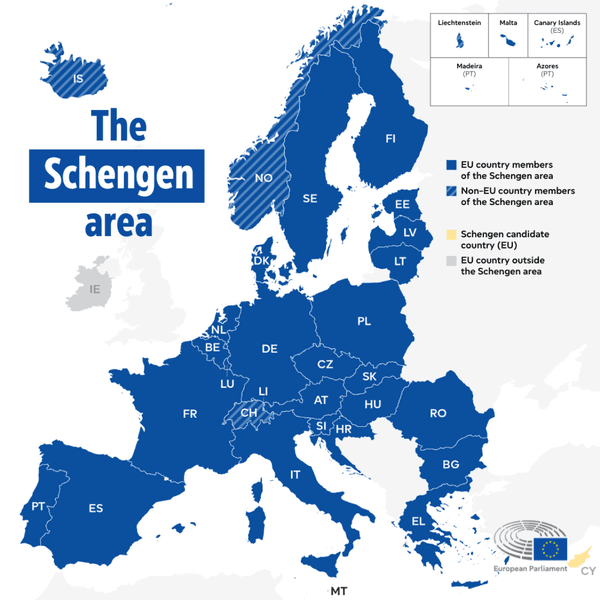
🇪🇺 Schengen vs non-Schengen destinations for Russian travellers
Destination | Schengen Area? | Visa type required for Russians |
|---|---|---|
France 🇫🇷 | ✅ Yes | Schengen visa (Type C) |
Germany 🇩🇪 | ✅ Yes | Schengen visa (Type C) |
Spain 🇪🇸 | ✅ Yes | Schengen visa (Type C) |
Switzerland 🇨🇭 | ✅ Yes | Schengen visa (Type C) |
Italy 🇮🇹 | ✅ Yes | Schengen visa (Type C) |
United Kingdom 🇬🇧 | ❌ No | UK visa (not Schengen) |
Turkey 🇹🇷 | ❌ No | Turkish visa regime |
Serbia 🇷🇸 | ❌ No | Separate Serbian entry rules |
UAE 🇦🇪 | ❌ No | UAE visa regime |
Georgia 🇬🇪 | ❌ No | Separate Georgian rules |
✅ Summary for Russian citizens
- All Russian passport holders must apply for a Schengen visa to visit Schengen countries
- One visa allows travel across the entire Schengen zone
- The maximum stay permitted is 90 days within any 180-day period
This section helps target the key search intents:
Planning your trip also means preparing a complete visa file, including mandatory Schengen travel insurance covering at least €30,000. Many Russian travellers now choose to compare policies online to save time and receive an instant certificate to attach to their application. With HelloSafe, you can easily compare trusted Schengen-approved insurance plans and download your certificate in just a few minutes.

Get your Schengen travel insurance certificate in 2 minutes
How to get a Schengen visa from Russia (step by step)
Step 1: Prepare your Schengen visa documents checklist 📂
Before booking your appointment, make sure your application file is complete and consistent. Missing or unclear Schengen visa documents are one of the most common reasons for delay, or refusal.
Here’s what you must include:
- ✔ Completed Schengen visa application form (signed)
- ✔ Valid passport (issued within the last 10 years, valid 3 months after departure, ≥2 blank pages)
- ✔ Biometric photo meeting ICAO standards
- ✔ Proof of accommodation (hotel booking, invitation, rental, etc.)
- ✔ Return flights or credible travel plan
- ✔ Proof of sufficient financial means (bank statements, employment, pension, sponsor)
- ✔ Mandatory Schengen travel medical insurance
minimum €30,000 coverage
includes repatriation
valid in all Schengen states for the whole stay - ✔ Proof of ties to Russia (employment, studies, property, family, etc.)
- ✔ Visa fee + service fee receipts
🧭 Documents by purpose of travel (quick guide)
🎯 Trip purpose | 📄 Extra documents required | 💡 Useful tip |
|---|---|---|
Tourism 🏖️ | Hotel bookings, itinerary, return flights | Avoid unrealistic itineraries |
Family visit 👨👩👧 | Invitation + proof of relationship | Attach host’s residence permit if applicable |
Business 💼 | Employer letter, conference/event proof | Dates must match your bookings |
Medical 🏥 | Treatment confirmation + payment guarantee | Insurance must clearly cover medical care |
Study (short-term) 🎓 | School/university invitation | Show funding for the whole stay |
Step 2: Book your appointment in Russia (TLS, BLS, VFS…) 📅
To submit your Schengen visa application from Russia, you’ll typically need to book an appointment at an official visa application centre. These centres are operated by authorised service providers such as TLScontact, VFS Global and BLS International, on behalf of various Schengen consulates.
Key points to know before booking:
- Appointments can be scarce and fill up quickly, especially in peak travel season.
- Visa centres charge a service fee in addition to the Schengen visa consular fee.
- Most centres require you to book online in advance and bring your application, documents and biometric data on the appointment day.
🗺️ Main visa application centres in Russia
📍 Centre | City | Consulates served | How to book |
|---|---|---|---|
TLScontact – Visa Application Centre Moscow | Moscow | Multiple Schengen states (France, Belgium, etc.) | Book via the official TLScontact portal (find your country & appointment) |
VFS Global – Visa Centre St. Petersburg | St. Petersburg | Schengen (France, Germany, etc.) | Book via VFS Global Russia online tool |
VFS Global – Visa Centre St. Petersburg | St. Petersburg | Schengen & other visas | Book via the dedicated VFS Global appointment system |
VFS Global – Visa Centres in Regional Cities | Moscow, Kazan, Krasnodar, Ekaterinburg, Novosibirsk, Rostov-on-Don, Kaliningrad, Vladivostok, etc. | Schengen consulates (varies) | Appointments via VFS Global portal, inquire early |
BLS International – Spain Visa Centre | Moscow & other regions | Spain Schengen visa | Appointments on the official BLS Spain Russia site |
BLS International – Portugal Visa Centres | Moscow, Saint Petersburg, Kazan, Ekaterinburg, Samara, Nizhny Novgorod, Novosibirsk | Portugal visa (Schengen) | Book via the BLS Portugal site |
🔗 Official portal to start the appointment process:
- TLScontact: visit their country-specific visa page and choose “Book appointment” (often national embassy domains link to TLScontact).
- VFS Global: search for “apply visa” and use the book appointment function on the Russia portal.
- BLS Spain/Portugal: use the official Spain or Portugal visa centre portals.
Step 3: Buy Schengen travel insurance online 💶
Travel insurance is mandatory for every Schengen visa application.
Your policy must:
- ✔ Cover at least €30,000 in medical expenses
- ✔ Include repatriation
- ✔ Be valid in all Schengen countries
- ✔ Cover your full stay dates
A digital PDF insurance certificate is normally required as proof.
💡 Many travellers prefer buying online because the certificate is issued instantly.
You can compare Schengen-compliant policies and purchase directly via platforms like HelloSafe, which deliver the certificate within minutes, convenient when appointments are last-minute.
Step 4: Submit your application and biometrics at the visa centre 🖐️
On the day of your appointment:
- Your Schengen visa documents are checked
- Your fingerprints and photo are taken
- You pay the remaining fees
- Your passport is collected for processing
You may also be asked additional questions about your trip.
Step 5: Track your Schengen visa application and wait for the decision 📬
- Standard processing time = about 15 calendar days
- In some cases, review can take up to 45 days
You will receive notifications when:
- your application is being processed
- your passport is ready for collection or delivery
Step 6: Travel to the Schengen Area with your visa ✈️
Before departure:
- ✔ Check your Schengen visa sticker
- ✔ Respect the 90-days-in-180-days rule
- ✔ Carry your insurance + trip documents
- ✔ Be ready to show proof of funds and return ticket at border control
Once admitted, you may move freely between Schengen countries, as long as your visa remains valid.
How much does a Schengen visa from Russia cost in 2026?
If you’re applying for a short-stay Schengen visa (Type C) from Russia, the total price of a Schengen visa includes the official visa fee, the service fee charged by the visa centre, and the mandatory Schengen travel insurance. Here’s what you should expect to pay in 2026.
Official Schengen visa fee (Type C):
- €90 (≈ ₽9,000): adults aged 12+
- €45 (≈ ₽4,500): children aged 6–11
- €0: children under 6
These consular fees are non-refundable, even if your visa is refused.
Because applications from Russia must be submitted through external service providers such as TLScontact, VFS Global or BLS, a service fee is also charged. This is usually around €20–€40 (≈ ₽2,000–₽4,000) depending on the provider and city. Optional extras like SMS updates, courier delivery or premium lounge services cost more.
Every applicant must also purchase Schengen-compliant travel medical insurance with at least €30,000 coverage, valid across all Schengen states for the entire stay. For a short trip of 7–14 days, plans typically cost €20–€60 (≈ ₽2,000–₽6,000) depending on age and insurer. Many travellers choose to buy online because the certificate is issued instantly, and platforms such as HelloSafe make comparison and purchase quick and simple.
💶 Total Schengen visa cost from Russia (2026)
Cost item | Amount in € | Approx. RUB equivalent | Notes |
|---|---|---|---|
Visa fee (adult 12+) | €90 | ≈ ₽9,000 | Official Schengen fee |
Visa fee (age 6–11) | €45 | ≈ ₽4,500 | Reduced rate |
Visa fee (under 6) | €0 | ₽0 | Free |
Visa centre service fee | €20–€40 | ≈ ₽2,000–₽4,000 | TLS / VFS / BLS |
Travel insurance | €20–€60 | ≈ ₽2,000–₽6,000 | Mandatory: €30,000 cover |
Optional services | €5–€50+ | ≈ ₽500–₽5,000+ | Courier, SMS, premium desk |
✅ Example total cost
For one adult traveller:
€90 visa fee + €30 service fee + €30 insurance = ~€150 total
≈ ₽15,000 in total
🔎 Good to know
- All payments are made per applicant
- Charges are usually processed in roubles (RUB) using the visa centre’s exchange rate
- Exchange rates may fluctuate slightly
- Keep all receipts in case your file is reviewed
Is Schengen travel insurance mandatory from Russia and which policy do you need?
Yes, Schengen travel medical insurance is mandatory for every Russian citizen applying for a short-stay Schengen visa (Type C). Without valid insurance, your application will be considered incomplete and may be refused. The policy must meet the official Schengen rules: at least €30,000 medical coverage, repatriation included, valid in all Schengen countries, and covering the entire duration of your stay. A PDF insurance certificate is normally required as proof and may also be checked at the border.
This applies to all trip purposes: tourism, family visits, business, study or medical travel. As long as your insurance is compliant and clearly documented, it supports the credibility and completeness of your application.
🛡️ How Russian travellers usually buy Schengen travel insurance
💳 Option | 👍 Advantages | ⚠️ Things to check |
|---|---|---|
🏦 Local Russian bank/insurer | Familiar provider, assistance in Russian | Certificate must clearly state €30,000+ cover, repatriation, Schengen-wide validity |
🌍 International travel insurer | Certificates widely recognised | Check accepted payment methods |
💻 Online comparison platform (e.g. HelloSafe) | Instant PDF certificate, compare prices easily, simple online purchase | Upload the final signed certificate to your visa file |
Some insurers also refund the premium if your visa is refused, upon presenting the official refusal letter. Conditions vary by provider, so it’s worth checking this point before purchasing, especially given the stricter screening currently applied to Russian applications.
In short:
✔ Insurance is compulsory
✔ €30,000 minimum + repatriation
✔ Valid in all Schengen states
✔ Covers the entire stay
✔ Certificate required at submission
If you want a fast, compliant and budget-friendly option, you can compare Schengen-approved travel insurance plans online with HelloSafe, and receive your certificate instantly by email, ready to add to your visa application.
How long does Schengen visa processing take from Russia?
From Russia, the standard processing time for a Schengen visa is usually about 15 calendar days from the date you submit your biometrics and documents at the visa centre. However, in practice, Russian travellers often experience longer waiting times around national holiday periods and peak travel seasons, when appointment slots and embassy workloads are under heavier pressure.
In particular, applicants in Moscow, Saint Petersburg, Kazan, Ekaterinburg and Novosibirsk report that the queue can grow significantly before major Russian holidays or during school breaks, meaning the real waiting time may include both appointment delays and the processing period.
⏱️ Standard Schengen processing time from Russia
Most applications are processed in ≈ 15 calendar days
🕒 When processing often takes longer (Russia-specific)
Processing may extend to 30–45 days, and appointments may become scarce, especially during:
- 🎄 New Year & Orthodox Christmas period (late December – early January)
Russians traditionally travel abroad during the long winter holidays (often 1–8 January) - 🌷 Spring holiday season (March–April)
Including Maslenitsa period, early spring tourism and Easter travel - 🇷🇺 May national holidays (1–9 May)
Labour Day & Victory Day week: very strong outbound travel demand - ☀️ Summer holidays (June–August)
Peak tourist season for Europe: families, students, group tours - 🎒 Back-to-school period (late August–September)
Parents and students finalise short-term stays and exchanges - 🎗️ November public holidays (4 November, National Unity Day)
Often linked with short international trips
In regional cities, files may also take longer due to internal routing times to the relevant consulate.
📆 When should you apply from Russia?
- Earliest allowed: up to 6 months before travel
- Latest allowed: 15 days before departure (strongly discouraged)
- Best practice for Russian travellers: 👉 Apply 4–8 weeks before travel, and even earlier if travelling in January, May, June–August or early November
This buffer is important in Russia because getting an appointment may already take time before your application is formally submitted.
✅ Key takeaway for Russian applicants
Expect ≈15 days in normal periods,
but plan for up to 45 days around New Year holidays, May celebrations, and the summer season, when Schengen visa demand from Russia is at its highest.
Which Schengen country is easiest for Russian citizens now?
There is no officially “easier” Schengen country for Russian citizens. All Schengen states apply the same EU Visa Code, and approval always depends on your main destination, the strength of your documents, and your travel history. However, Russian applicants often compare approval trends and refusal rates by country to better understand the landscape.
The safest rule remains:
👉 Always apply through the country where you will spend the longest time (or first enter if your stay is split equally).
🌍 Schengen visa applications from Russian citizens, by destination country (latest available data)
Country | Russian applications | Refusals | Refusal rate |
|---|---|---|---|
France 🇫🇷 | ~154,000 | ~10,600 | ≈ 6.9% |
Spain 🇪🇸 | ~142,000 | ~9,500 | ≈ 6.7% |
Italy 🇮🇹 | ~106,000 | ~6,400 | ≈ 6.0% |
Germany 🇩🇪 | ~71,000 | ~7,700 | ≈ 10.8% |
Greece 🇬🇷 | ~33,000 | ~2,400 | ≈ 7.2% |
Finland 🇫🇮 | ~29,000 | ~2,300 | ≈ 7.9% |
Czech Republic 🇨🇿 | ~22,000 | ~2,300 | ≈ 10.6% |
Netherlands 🇳🇱 | ~18,000 | ~2,100 | ≈ 11.6% |
Switzerland 🇨🇭 | ~17,000 | ~900 | ≈ 5.5% |
Portugal 🇵🇹 | ~11,000 | ~300 | ≈ 2.6% |
📌 Context for Russian citizens (all Schengen countries combined):
≈ 606,600 applications and ≈ 44,900 refusals, average refusal rate ≈ 7.5%
🧭 How to read these numbers
- Some countries receive a very high volume of Russian applications (France, Spain, Italy)
- Refusal rates vary slightly between consulates
- A low refusal rate does not mean easier rules: the legal criteria are identical
- Approval depends mainly on your documents and ties to Russia
🔑 What Russian applicants tend to compare
- Appointment availability in Russian cities
- Expected processing time
- Clarity of document checklists
- Past experience shared online by other travellers
✅ Practical takeaway
Use statistics as context, not strategy.
The best approach remains: apply through your true main destination and submit a clear, well-documented file (financial proof, itinerary, insurance, and ties to Russia).
Why are Schengen visas refused for Russians and how can you avoid refusal?
In 2024, Schengen visa refusals remained strongly linked to administrative and financial criteria: consulates around the world, and for Russian applicants in particular, continue to prioritise proof of funds, compliant insurance and a clear purpose of travel when assessing applications. According to the HelloSafe Schengen Visa Refusal Barometer 2025, the leading refusal reasons globally were well-documented.
Most frequent refusal reasons, with real statistics & how to avoid them
Reason for refusal | % of all visa refusals (global data) | What it means | How to avoid it |
|---|---|---|---|
Insufficient financial resources | 21% | Consulate doubts your ability to cover travel, accommodation and daily expenses | Provide 3–6 months of bank statements, salary slips, sponsor proof |
Non-compliant travel insurance | 15% | Insurance lacks required Schengen cover or repatriation | Buy compliant €30,000+ insurance and include certificate |
Unclear or unjustified travel purpose | 12% | Weak itinerary or invitation that does not clearly justify trip | Provide a detailed itinerary + valid invitation/booking |
Doubts about return to home country | 12% | Insufficient ties shown with Russia | Add employment/study proof, family situation, property proof |
Incomplete documentation | 7% | Missing or inconsistent paperwork at submission | Cross-check your file with the official checklist |
Other administrative reasons (history, accommodation, inconsistencies) | 33% | Miscellaneous compliance issues flagged by consulates | Ensure all document sections are consistent and credible |
📝 What this means for Russian applicants
These figures reflect global Schengen visa refusal patterns, but they are highly relevant for Russian citizens too, since the main refusal triggers (money, insurance, unclear purpose) are similar irrespective of nationality.
📌 Practical takeaway
➡️ A strong Schengen visa application minimises refusal triggers by addressing the top documented factors:
- Sufficient financial proof
- Compliant Schengen travel insurance (€30,000+ with repatriation)
- Clear purpose of stay and itinerary
- Full and consistent document set
This evidence-based perspective makes the refusal discussion more concrete while keeping the advice actionable.
How should you fill in the Schengen visa application form and cover letter from Russia?
Filling in the Schengen visa application form correctly is essential: even small mistakes can cause delays or refusal. Russian applicants must complete the harmonised Schengen form, either online (when available) or on paper, then submit it at the visa centre together with supporting documents.
Below is a simple guide to help you complete both the application form and the cover letter clearly and consistently.
📨 How to fill in the Schengen visa application form (step by step)
When completing the form:
- Use English (or the language required by the consulate)
- Ensure all dates match your bookings
- Avoid leaving fields blank (write “N/A” if not applicable)
Key sections to pay attention to:
- Personal data → must match your passport exactly
- Travel document details → correct passport number & expiry date
- Purpose of travel → choose: tourism / family visit / business / study / medical etc.
- Main destination country → where you will stay the longest
- Number of entries → usually “single entry” for most Russian applicants
- Duration of stay → days of stay, not calendar period
- Funding → who pays? you / family / company (attach proof)
- Previous Schengen visas → declare honestly
- Insurance → confirm €30,000+ Schengen-compliant travel insurance
Before printing/signing:
- Check spelling of names, passport number, dates
- Ensure your signature matches your passport
- Make sure the form and your documents tell the same story
✍️ How to write a strong Schengen visa cover letter from Russia
A cover letter is not always mandatory, but it greatly helps consulates understand your trip, especially for Russian applicants whose files may be examined more closely.
Your letter should include:
- Who you are (job, city, family situation, briefly)
- Purpose of travel
- Exact travel dates
- Accommodation details
- Funding & financial proof
- Travel history (if any)
- Confirmation you will return to Russia
You can close the letter with a short insurance statement such as:
“I have purchased Schengen travel medical insurance covering at least €30,000 for all Schengen countries during my entire stay.”
📝 Simple cover letter template (you can adapt)
Dear Sir/Madam,
My name is [Full Name], a Russian citizen living in [City]. I am applying for a Schengen short-stay visa (Type C) to visit [Country] from [Arrival Date] to [Departure Date] for [tourism / family visit / business].
I will stay at [hotel / host address] and I have attached proof of accommodation and return flights. The trip will be funded by [myself / sponsor], and I have included bank statements and employment confirmation.
I have strong ties to Russia, including [employment / family / property / studies], and I will return after my trip. I have also purchased Schengen-compliant travel insurance of at least €30,000 for the full duration of my stay.
Thank you for considering my application.
Kind regards,
[Name + Signature]
✅ Final checks before submitting your form
- ✔ All names & passport data are correct
- ✔ Dates match flights & hotel bookings
- ✔ Purpose of travel is clear
- ✔ Financial proof is attached
- ✔ Insurance meets €30,000 + repatriation rules
- ✔ You signed the form & cover letter
A clear and consistent application helps reassure consulates and supports a smooth Schengen visa process from Russia.
Can Russian citizens still get multiple-entry Schengen visas or long-term visas?
In the current context, most Russian citizens receive single-entry Schengen visas valid only for one trip. While the EU Visa Code still allows multiple-entry visas (MEV) and long-validity visas (1–5 years), these are now rarely granted to applicants residing in Russia, except in specific situations.
A Schengen short-stay visa always follows the “90 days in any 180-day period” rule, even if the visa is multiple-entry. What changes with a multiple-entry Schengen visa is not the length of stay, but the possibility to enter and leave the Schengen Area several times during the validity period.
Below is a summary of the current situation 👇
⏳ Multiple-entry & long-term Schengen visas for Russian citizens
🛂 Visa type | 🔁 Entries allowed | ⏱️ Typical validity | 👤 Who may still receive it? | ℹ️ Notes |
|---|---|---|---|---|
Single-entry short-stay visa (Type C) | 1 entry | Matches trip dates | Most Russian applicants | Now the most common outcome |
Multiple-entry visa (MEV) | Several entries | 6–12 months (or more, rarely) | Exceptional cases only | Still subject to 90/180-day rule |
Long-term MEV (1–5 years) | Several entries | 1–5 years | Very rare, typically for highly trusted profiles | Strong travel history & EU links required |
National long-stay visa (Type D) | Multiple entries | >90 days | Students, residents, workers | Not a Schengen tourist visa |
🔒 Who still qualifies for multiple-entry or long-validity visas? (rare cases)
Multiple-entry visas may still be granted to:
- Close family members of EU citizens or legal residents
- Frequent business travellers with a solid history of compliance
- Transport or crew professionals
- Individuals with strong humanitarian reasons or public-interest travel
- Trusted profiles with multiple previously compliant Schengen trips
But even in these categories, approval is not automatic and depends on the consulate’s assessment.
Your photo must usually be 35×45 mm, in colour, taken within the last 6 months, on a light background, with a neutral expression and no head coverings (unless for religious reasons). Glasses are normally discouraged unless medically necessary. The photo must clearly show your full face without shadows or reflections.
Yes. Most applicants must provide fingerprints and a digital photo at the visa centre. Once taken, biometrics remain valid for 59 months (almost 5 years). If you applied recently and your prints are still valid, you may not need to provide them again, unless the consulate requests new ones.
Your visa number appears on the visa sticker inside your passport. It is usually located near the top or next to the barcode. The sticker also displays your validity dates, duration of stay and number of entries (1, 2 or MULT). Always check these carefully before departure.
Some Russian travellers do require an Airport Transit Visa (ATV) depending on the Schengen country and the flight route. This is particularly relevant if you need to change terminals or pass border control. If you leave the airport or stay overnight, you will need a regular short-stay Schengen visa (Type C).
Yes. Every child, including infants, needs an individual visa. A birth certificate and parental consent form may be requested when only one parent travels. Children must also be covered by Schengen-compliant travel insurance, either individually or under a family policy.
In most cases, you must apply in the country where you legally reside. If you are temporarily in another country (e.g. Turkey, UAE, Georgia, Serbia), you can usually only apply there if you hold legal residence or long-term permission. Otherwise, you should submit your application from Russia.
This rule limits your total stay inside the Schengen Area to 90 days within any rolling 180-day period, regardless of the number of entries. Even with a multiple-entry visa, you must respect this limit unless you hold a national long-stay visa (Type D).
No. The €90 visa fee is non-refundable. However, some travel insurers offer a refund of the insurance premium if your visa is refused, provided you submit the official refusal letter. Conditions vary depending on the insurer.
Travel insurance is mandatory but does not guarantee approval. However, non-compliant insurance (less than €30,000 coverage, missing repatriation, not valid in all Schengen states or wrong validity dates) can cause refusal or rejection of the file, so it is important to choose the correct policy.
Yes. A Schengen visa allows you to travel freely within the Schengen Area as long as your visa is valid and you respect the 90-days-in-180-days rule. You must always apply through the country where you will spend the longest time (or your first entry if the stay is equal).
Yes. You will receive a written refusal decision explaining the reason. You can then correct the issues (documents, finances, ties to Russia, itinerary, etc.) and submit a new application. In some countries, you may also appeal within a legal deadline.
Most consulates expect confirmed accommodation and a clear travel plan. Fully paid tickets are not always required, but your itinerary must be credible and consistent. Many Russian applicants choose refundable bookings to keep flexibility.
The legal framework for Schengen visas remains the same, but in practice applications from Russian citizens are often examined with greater scrutiny than before 2022. This may sometimes mean stricter verification of financial proof, travel purpose and ties to Russia, and in certain periods longer processing times or fewer available appointments. A complete, well-documented file significantly improves approval chances.
Yes. Hundreds of thousands of Schengen visas are still issued every year to Russian citizens for tourism, business and family visits. The key factor is the credibility and consistency of your application, including proof of funds, accommodation, itinerary and travel insurance.
On the same topic

Schengen visa sticker explained 2026: read every field
Oct 20, 2026

Sponsorship letter sample for visa: complete guide for Schengen applications
Oct 11, 2026

TLScontact Schengen visa 2026: book, track, fees, contact
Oct 1, 2026