How to get a Schengen visa from the US (Complete 2026 Guide)
 A. FruchardCo-Founder & Travel Insurance ExpertLast updated: September 30, 2026
Travelling from the US to Europe is easy — unless you need a Schengen visa. For many US residents without a US passport, the rules can be confusing: different consulates, strict documents, long waits and a real risk of refusal.
This guide cuts through the noise and explains who actually needs a Schengen visa from the US, how the process works, how long it takes, how much it costs, and how to avoid the most common mistakes — including the mandatory travel medical insurance requirement.
- 🇺🇸 US citizens: no Schengen visa needed for tourism or business stays up to 90 days within any 180-day period.
- 🛂 Non-US citizens living in the US (H-1B, F-1, J-1, EAD, Green Card): Schengen visa usually required, depending on nationality.
- 📊 150,000+ applications per year from the US; refusal rate slightly below the global average (14–15%).
- 💶 Visa fees: €90 (adults), €45 (children 6–11), free under 6 (updated June 2024).
- ⏳ Processing time: usually up to 15 days, can reach 45 days during peak seasons.
- 🛡️ Travel medical insurance is mandatory: minimum €30,000 coverage, valid in all Schengen countries, for the full stay.
Who actually needs a Schengen visa from the US?
A Schengen visa allows stays of up to 90 days within any 180-day period for tourism, business, family visits or short courses. The most common is the short-stay Type C visa, but other Schengen visa types also exist.
🔑 Key rule to remember: Your citizenship matters — not your US residence. Schengen visa requirements depend on the passport you hold, even if you live legally in the US.
In practice:
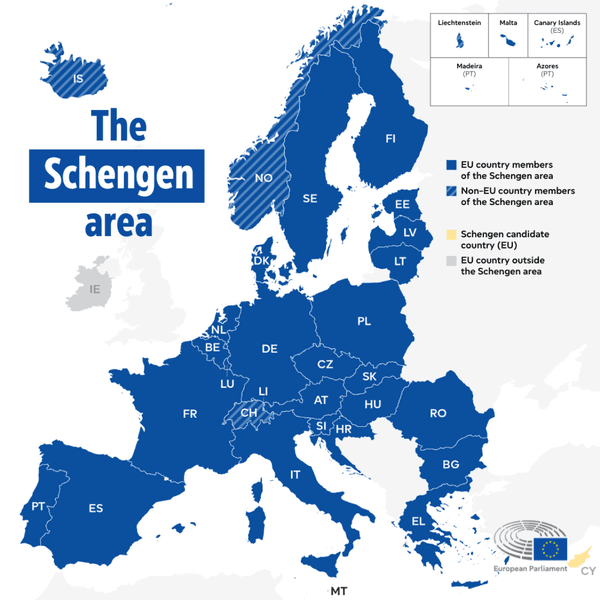
- 🇺🇸 US & Canadian passports → ❌ No Schengen visa needed (ETIAS required from 2026)
- 🇧🇷 Brazilian passport → ❌ No Schengen visa needed
- 🇮🇳 🇨🇳 🇲🇦 🇷🇺 Indian, Chinese, Moroccan, Russian passports → ✅ Schengen visa required, even with a Green Card or US visa
🛂 US residents without a US passport
If you hold a visa such as H-1B, F-1, J-1, EAD or a Green Card, you still need a Schengen visa if your nationality is visa-required.
These nationalities also represent a large share of US-based applicants (China, India, Turkey, Morocco…), mainly among tech workers, students and family travellers.
🛡️ Reminder: all applicants must provide Schengen-compliant travel medical insurance (minimum €30,000 coverage) when applying. Many US-based travellers prefer to compare certified policies online and download the certificate instantly through HelloSafe, which makes preparing the visa file much simpler.

Get your Schengen travel insurance certificate in 2 minutes
What are the Schengen visa requirements from the US?
If you live in the United States and your nationality requires a Schengen visa, your application must comply with the EU Visa Code, plus a few US-specific conditions linked to your immigration status and state of residence.
A short-stay visa (Type C) is only granted if your stay is 90 days or less within any 180-day period, your purpose of travel is legitimate (tourism, business, family visit, study or medical), you can show sufficient financial means, you hold travel medical insurance of at least €30,000 (≈ $33,000) valid across all Schengen states, and you can clearly demonstrate your intention to return to the US after your trip.
When applying from inside the US, consulates also verify that you are legally resident in the United States (for example Green Card, valid US visa, I-94 or EAD) and that you apply through the correct consulate for your US state of residence. This is why appointments are handled via centres such as VFS Global or TLScontact depending on where you live.
Below is a practical summary of what consulates expect to see in your file:
Requirement | What it means | Typical proof |
|---|---|---|
🕒 Maximum stay | Up to 90 days in any 180-day period | |
🎯 Purpose of travel | Tourism, family visit, business, study, medical | Hotel booking, invitation letter |
💳 Proof of funds | You can finance your stay | Bank statements, payslips, tax return |
✈️ Return intention | You will leave Schengen before expiry | Round-trip ticket, employment letter, lease |
🛂 Legal US residence | You are lawfully resident in the US | Green Card, US visa, I-94, EAD |
📍 Jurisdiction | Correct consulate for your US address | Proof of address |
🛡️ Travel medical insurance | Minimum €30,000 (~$33,000) emergency + repatriation cover, valid in all Schengen states for your full stay | Insurance certificate (PDF) |
How to get a Schengen visa from US?
Applying for a Schengen visa from the United States follows a clear process. The key is to submit your file to the right consulate and to make sure every document required for your Schengen visa application is correct and consistent. Here is the full step-by-step path 👇
Step 1 – Check if you actually need a Schengen visa 🕵️♀️
- US citizens do not need a visa for trips under 90 days (in any 180-day period).
- Non-US citizens living in the US usually do, including holders of Indian 🇮🇳, Chinese 🇨🇳, Turkish 🇹🇷, Moroccan 🇲🇦, Nigerian 🇳🇬, Filipino 🇵🇭 passports, even with a Green Card.
- Rules depend on citizenship — not US residence.
Step 2 – Choose your main destination and consulate 🗺️
Apply to the country where you spend the most nights. If equal, apply to your first Schengen entry country.
Most visas are processed via VFS Global, TLScontact or BLS International. Busiest centres for US residents include New York, Los Angeles, San Francisco, Houston and Miami.
Country | Typical US locations | Visa partner |
|---|---|---|
🇫🇷 France | New York, DC, Miami, Houston, LA, SF, Chicago, Seattle | VFS / TLS |
🇮🇹 Italy | Boston, New York, Miami, Houston, LA, SF | VFS |
🇪🇸 Spain | New York, Miami, Houston, LA, Chicago, SF | BLS |
🇩🇪 Germany | DC, New York, Houston, Chicago, SF | VFS |
🇳🇱 Netherlands | DC, Miami, Houston, LA, SF, New York | VFS |
🇨🇭 Switzerland | New York, Atlanta, San Francisco | VFS |
🇵🇹 Portugal | DC, New York, San Francisco | VFS |
👉 You must apply at the centre responsible for your US address.
Step 3 – Understand the 90/180-day rule and your travel dates 🗓️
You may stay up to 90 days within any rolling 180-day period.
Example: 11 days in March + 10 in June = 21 days used.
Step 4 – Gather all the required documents 📑
Document | Required? | Notes for US-based applicants |
|---|---|---|
Schengen visa application form | ✅ Yes | Completed & signed |
Valid passport | ✅ Yes | Usually valid 3+ months beyond return date, 2 blank pages |
Proof of legal US residence | ✅ Yes | Green Card, US visa, I-94, EAD etc. |
Passport photos | ✅ Yes | Biometric format |
Flight reservation / travel plan | ✅ Yes | Round-trip or onward journey |
Accommodation proof | ✅ Yes | Hotel bookings or invitation letter |
Proof of funds | ✅ Yes | Bank statements, payslips, tax return |
Travel medical insurance | ✅ Yes | Minimum €30,000, valid in all Schengen, full stay covered |
Employment or enrolment letter | Often required | Shows ties to the US |
Recommended | Explains purpose and itinerary |
Step 5 – Buy your Schengen visa travel insurance 🛡️
Your policy must include:
- €30,000 (~$33,000) emergency medical + repatriation
- Valid in all Schengen countries
- Covering your full stay
Most US applicants buy online and download the certificate instantly. Many compare compliant policies via HelloSafe to get the best price.
Step 6 – Book your Schengen visa appointment in the US 📅
Most appointments are made via:
Country | Platform | Typical locations |
|---|---|---|
🇫🇷 France | VFS / TLS | New York, Miami, Houston, LA, SF, Chicago, DC, Seattle |
🇮🇹 Italy | VFS | Boston, New York, Miami, LA, SF, Houston |
🇪🇸 Spain | BLS | New York, Miami, Houston, LA, Chicago, SF |
🇩🇪 Germany | VFS | DC, New York, Houston, Chicago, SF |
🇳🇱 Netherlands | VFS | DC, Miami, Houston, LA, SF, New York |
Premium services exist (Prime-Time, VIP lounge, Visa at Your Doorstep).
Appointments fill fast before summer & Christmas.
Step 7 – Submit biometrics, pay the visa fee and track your application 💳
Official Schengen visa fees:
- €90 (~$99–$105) adults
- €45 (~$50–$53) children 6–11
- Free under 6
Service centre fees apply.
Processing time: up to 15 days (sometimes up to 45 days in peak season).
Step 8 – Collect your passport and check your Schengen visa carefully 🔍
Verify:
- validity dates
- number of entries
- “Schengen States” territory
- your personal details
Keep copies of documents when travelling.
How much does a Schengen visa cost from the US?
💰 Total cost: most adults pay $120–$200 in total (excluding flights & accommodation).
This includes:
- 💶 Schengen visa fee: €90 (≈ $99–$105) | 👶 €45 (≈ $50–$53) for children 6–11 | Free under 6
- 🏢 Visa centre service fee (VFS/TLS): €25–€40 (≈ $27–$45)
- 🛡️ Mandatory travel medical insurance: €20–€60 (≈ $25–$70)
ℹ️ Fees are EU-wide, non-refundable, and paid in USD at the visa centre’s exchange rate.
Item | Amount (EUR) | Approx. in USD | Notes |
|---|---|---|---|
Schengen visa fee (adult) | €90 | $95–$105 | Fixed EU fee |
Visa centre service fee | €25–€40 | $27–$45 | Paid to VFS/TLS |
Optional premium services | €20–€150+ | $22–$165+ | Optional |
Travel medical insurance (10–15 days) | €20–€60 | $25–$70 | Mandatory for all applicants |
(USD values depend on exchange rate. Figures are indicative but realistic for US-based applicants.)
In the US, applications are usually submitted via VFS Global or TLScontact, which charge an extra €25–€40 service fee (paid in USD). Optional services and passport courier are extra, so the total cost is higher than the €90 visa fee.
How long does a Schengen visa take to process from the US?
Schengen Visa processing time is one of the main concerns for US-based applicants. While the official timeframe is set at EU level, real-world delays in the United States often depend on travel seasons, local demand and even major events or holidays across the country.
- ⏳ Standard processing: up to 15 calendar days
- ⚠️ Maximum legal delay: up to 45 days (extra checks, high demand)
📅 Delays are more common during:
- Summer (May–September)
- Spring Break (March–April)
- Thanksgiving & Christmas–New Year
- Major events in cities like NYC, LA, SF, Miami, Houston
🗓️ When to apply:
- ✅ Ideally 1–3 months before departure
- ⚠️ Absolute minimum: 3–4 weeks, avoid peak seasons if possible
Travellers in California, Texas, Florida and New York report the most competition for slots due to high immigrant populations and tourism traffic.
Which Schengen country should you apply to from the US?
One of the most common questions from US-based travellers is:
“Should I apply for a France Schengen visa, Italy Schengen visa, Spain Schengen visa… or does it even matter?”
The answer is simple — you must apply through the country that is responsible for your trip, based on clear Schengen rules. Here’s how to work it out 👇
Main destination vs first entry rule 🧭
Schengen states follow a shared rule to decide which country processes your application:
- If you are visiting only one Schengen country, you apply there (for example, only Italy → Italy processes your visa).
- If you visit several countries, you apply to the country where you will spend the most nights. This is called your main destination.
- If your time is exactly equal in two or more countries, you apply through the country of first entry — meaning the one where you first arrive in the Schengen Area.
Examples:
- 10 nights in Italy + 4 in France → apply to Italy
- 5 nights in Spain + 5 in Portugal, entering via Lisbon → apply to Portugal
- 4 nights in Greece + 4 in Italy, first landing in Athens → apply to Greece
Submitting to the wrong country may delay your case — so always calculate your nights first.
Is there an “easiest” Schengen visa from the US? 🤔
Online forums often ask which country is “easiest” — France, Italy, Spain, Germany, etc.
In reality, there is no guaranteed easiest Schengen visa. All consulates apply the same Visa Code, and global refusal rates fluctuate by country and by nationality. Some smaller countries such as Malta, Belgium or Estonia have historically shown higher refusal percentages, while large tourist destinations sometimes approve a greater share — but this varies year to year.
More importantly:
- The correct country is always the one that is your main destination.
- Choosing a different country just because you think it’s easier can result in refusal or re-direction.
- What matters most is a complete, consistent and well-documented application (including travel insurance, funds, proof of ties and itinerary).
So rather than chasing the “easiest” option, focus on presenting a strong file — that is what truly improves approval chances for applicants in the US.
Is Schengen visa travel insurance mandatory from the US?
Yes — if you need a Schengen visa, travel medical insurance is compulsory, even if you live legally in the United States. Your visa application will only be accepted if your policy meets the official Schengen travel insurance requirements. This rule applies regardless of the Schengen country you apply to.
Schengen visa travel insurance requirements explained 🛡️
To be accepted for a Schengen visa, your insurance policy must meet three non-negotiable criteria:
- Minimum medical coverage of €30,000
- Valid across all Schengen countries, without restriction
- Covering the full duration of your trip, from the day you leave the US until the day you return
Most consulates will also check that the certificate clearly states your name, coverage amount, dates and territorial validity. If any of these elements is missing, the visa centre may ask you to amend your policy before your file can be processed.
What does Schengen travel medical insurance actually cover? 🏥
Beyond the legal minimum of €30,000, most Schengen travel medical insurance plans provide a broad safety net for visitors. The idea is simple: if you fall ill or suffer an accident abroad, you should not have to pay out-of-pocket for emergency treatment or medical evacuation.
Here is what typical Schengen-compliant plans include:
Type of cover | What it means for you | Included for visa purposes? |
|---|---|---|
Emergency medical treatment | Doctor visits, medication and urgent care if you become ill or injured | ✅ Yes |
Hospitalisation & surgery | In-patient care, operating room and related medical services | ✅ Yes |
Medical evacuation & repatriation | Transport to another hospital or back to your home country if medically necessary | ✅ Yes |
24/7 assistance services | Emergency hotline, coordination with hospitals and family contact | ✅ Yes |
Accident cover | Lump-sum benefit in case of severe injury or disability | ⚠️ Often |
Personal liability | Covers accidental damage you cause to others | ⚠️ Sometimes |
Baggage or trip interruption | Compensation for loss, theft or disruption | ⚠️ Optional (not required for visa) |
The first four elements are the core reason Schengen insurance exists: they ensure visitors are protected and that European healthcare systems are not financially exposed.
Extra features like baggage, cancellation or personal liability are useful add-ons, but they are not mandatory for visa approval.
And importantly: having more coverage does not increase your chance of approval — the key is simply that the policy fully meets Schengen rules.
How much does Schengen visa travel insurance cost from the US? 🛡️
Travel medical insurance is mandatory for Schengen visa approval and must include at least €30,000 coverage for medical emergencies and repatriation, valid across all Schengen countries for your full stay.
From the US, insurance for a 10–15 day trip usually costs around:
- €20–€60
- or roughly $25–$70 USD, depending on age, coverage level and insurer
The price of your insurance does not affect your visa decision, as long as the policy meets Schengen requirements.
Comparators like HelloSafe help you see the price difference between several Schengen-compliant insurers in a few clicks, which is useful if you’re on a tight budget.
If you want to compare compliant plans quickly — including price, coverage level and flexibility — HelloSafe makes it easy to review several Schengen-ready policies online and download your certificate instantly, so you can move forward confidently with your visa application.
What are the main reasons for Schengen visa rejection – and how can US applicants reduce the risk?
Even if you prepare carefully, Schengen visa refusals do happen — and they can be stressful and expensive. Understanding why applications are refused helps US-based travellers submit a stronger file and avoid the most common pitfalls.
Global Schengen visa rejection rates 🔢
Recent data shows that the global Schengen visa refusal rate was exactly 14.8 % in 2024, based on 11.7 million short-stay (Type C) applications lodged worldwide. This means that nearly 15 out of every 100 applicants were denied a visa in the most recent statistical year.
However, the refusal landscape varies significantly depending on origin and region:
- Applications submitted from the United States had a lower refusal rate than the global average, around 10.2 % in 2024. This reflects generally stronger documentation, higher average financial means, and the fact that many applicants from the US hold long-term resident status (sometimes with documented ties and stable income).
- By contrast, applicants from several African countries experienced much higher refusal rates — often above 25 % — due to stronger scrutiny on economic ties and documentation.
- Some smaller Schengen states have historically recorded even higher refusal proportions (for example, Malta has appeared near 38–39 % in certain national statistics), though these figures can reflect particular consular practices and application profiles rather than overall policy.
These numbers are reported annually, and they fluctuate with travel patterns, seasonal peaks and policy changes. But one trend is consistent: many refusals result not from nationality alone, but from weaknesses in the application file — including incomplete documents, unclear travel intent, or insufficient proof of funds.
Typical refusal reasons for US-based applicants ⚠️
For travellers applying from inside the United States, most refusals fall into recurring, very practical categories. In many cases, the issue is not the trip itself — but the quality, clarity or credibility of the documents provided.
Here is a simple overview:
Reason for refusal | What the consulate thinks | Typical example |
|---|---|---|
Incomplete or inconsistent documents | The file does not meet Schengen Visa Code standards | Missing hotel booking, unsigned form, unclear invitation |
Insufficient financial means | Not enough proof you can support yourself during the trip | Low bank balance, unexplained cash deposits |
Unclear intention to return to the US | Risk that the applicant may overstay | No job letter, weak links to residence or studies |
Itinerary inconsistencies | Doubt about the reality or coherence of the trip | Main destination not defined, contradictory bookings |
Non-compliant travel insurance | Mandatory protection requirements not respected | Coverage below €30,000 or not valid for full stay |
Weak explanation of purpose | Trip objective not clearly justified | No supporting documents for business or family visits |
A key takeaway: most refusals are avoidable with a consistent itinerary, strong proof of ties to the US, clear funding evidence and fully compliant insurance.
How to protect your money if your Schengen visa is refused 💸
A refusal doesn’t only cost time — it can also cost money. Keep in mind:
- Schengen visa fees are non-refundable, even if your application is rejected.
- Flight bookings and accommodation deposits may only be partially refundable, depending on the fare rules.
- Some travel insurance policies include a refund clause if the visa is refused — meaning you get your premium back if you send proof of refusal.
Some policies you can compare via HelloSafe explicitly include a “visa refused = premium refunded” clause, which limits your financial risk.
Where possible, choose refundable or flexible bookings, and prepare a clean, well-documented application — this combination gives US-based applicants the strongest chance of approval while keeping costs under control.
What about ETIAS, EES and future rules for US travellers to Schengen?
If you’re planning a trip from the US to Europe, you may have heard about EES and ETIAS. These two new EU systems are designed to modernise border control and pre-travel screening — and they mainly concern visa-free travellers such as US citizens. Here’s what they actually mean in practice 👇
EES: biometric border checks instead of passport stamps 🧬
The Entry/Exit System (EES) is being rolled out to replace manual passport stamping at Schengen borders. Launch is scheduled for October 2025.
Under EES, each time you enter or leave the Schengen Area, the system will record:
- your identity data (from your passport)
- biometric information such as fingerprints and a facial image
- the exact date and border crossing point
This allows border authorities to calculate the 90/180-day rule automatically, so overstays can be detected more easily. For US citizens and other visa-free travellers, the airport process may take a little longer the first time because biometrics must be registered, but future crossings should be faster and fully digital.
ETIAS: future authorisation for visa-free travellers like US citizens 🎫
The European Travel Information and Authorisation System (ETIAS) is a pre-travel authorisation, not a visa. It is expected to go live towards the end of 2026.
Visa-free travellers — including US passport holders — will need to complete an online form before departure, pay a fee of about €20, and receive an electronic travel authorisation linked to their passport. ETIAS will normally be valid for three years or until the passport expires, whichever comes first.
Most applications should be approved automatically within minutes, although some travellers may be asked for extra information.
Will ETIAS change travel insurance for Schengen? 🤷♂️
Short answer: no. ETIAS is not a visa and does not introduce any new mandatory insurance requirement. However, medical treatment in Europe can still be expensive for non-residents — which is why travel medical insurance remains strongly recommended for all US travellers.
If you want to compare Schengen-compliant insurance quickly and download your certificate instantly, HelloSafe lets you review multiple plans online before you travel, whether or not you need a visa.
Most consulates require biometric photos sized 35mm x 45mm with a light background, a neutral facial expression and no shadows. Glasses are allowed only if there is no glare or reflection. Religious head coverings are accepted as long as the face is fully visible. Photos should generally be less than six months old. Many US photo centres now offer Schengen-compliant photos.
Each Schengen country publishes the official short-stay visa application form on its embassy or visa-centre website. Some allow you to fill out the form online before printing; others provide a downloadable PDF. Although the format is mostly standard, you must submit it to the correct consulate or visa centre for your US state of residence. Always sign the final printed version.
When your visa is approved, a secure sticker is placed inside your passport. It shows your visa number, your name, the validity dates, the number of entries and the territory (“Schengen States” in most cases). You should carefully verify these details as soon as you receive your passport. If anything is incorrect, contact the visa centre immediately.
Yes, in some circumstances. First-time applicants often receive a single-entry or short-validity visa, but frequent travellers with a strong history may be granted 1-year, 2-year or even 5-year multiple-entry visas. However, the 90-days-per-180-days rule still applies, regardless of the visa validity period. The decision rests entirely with the consulate.
Yes. The insurer does not need to be in the US. What matters is that the policy clearly states your full name, offers at least €30,000 coverage, is valid across all Schengen states, and covers the full period of your stay. The certificate must be printable or available as a PDF for submission with your application.
Often yes, but this depends on the insurer and your ticket conditions. Many Schengen-compliant policies allow date changes before coverage begins, and some even refund the premium if the visa is refused. If flexibility matters, choose a policy that clearly allows changes. Comparison tools such as HelloSafe make it easier to identify insurers offering these benefits.
No. Although travel medical insurance is mandatory, it is only one element of your visa application. Consulates also review your documentation, funds, itinerary and ties to the US. Still, compliant insurance prevents rejection for insurance-related reasons and protects you during your stay.
You can generally apply if you can prove your legal right to stay in the US at the time of application and return. If your US status is close to expiring, the consulate may doubt your intention to return, which increases refusal risk. Strong evidence of ties to the US becomes essential in such cases.
On the same topic

Schengen visa sticker explained 2026: read every field
Oct 1, 2026
Sponsorship letter sample for visa: complete guide for Schengen applications
Sep 30, 2026

TLScontact Schengen visa 2026: book, track, fees, contact
Oct 1, 2026